common myths about migraines (AKA if you get headaches regularly, please seek treatment for migraines)
“i don’t have migraines because while i get them several times a week, it’s only when i am hungry or dehydrated.”
those are probably migraines. thirst, hunger, sleep disturbances, or any disruption to routine are common migraine triggers.
“my headaches are specifically barometric related, i get them when the weather/altitude changes.”
those are probably migraines. barometric pressure is a common migraine trigger.
“i get headaches all the time but ibuprofen gets rid of them so they can’t be migraines.”
that’s not true. ibuprofen works great at relieving migraine pain for many people.
“my consistent headaches are tension headaches. i feel them originate in my neck/shoulders.”
those are probably migraines. muscle tension is a common migraine trigger.
if you are regularly getting headaches (once a week or more), you are likely getting migraines. in fact,a good rule of thumb if you’re consistently getting headaches is to treat them as migraines until you can rule out migraines. that’s how common “chronic headache = migraine” actually is.
migraines are a neurological disorder wherein pain is one symptom. pain is often the MAIN symptom, and the most noticeable symptom, which can make diagnosis tricky. other symptoms of migraine include:
fatigue
nausea/vomiting
digestive issues
visual disturbances (auras)
sensitivity to light and/or sound
mood changes
brain fog/cognitive changes
ringing in the ears
dizziness/vertigo
numbness/weakness on one side of the body
this list is NOT complete, but is a starting point. i really like the comparison to a hangover. if you generally feel hungover when you get a headache (without having consumed alcohol), that’s a classic migraine presentation.
so many people suffer from migraine and don’t even know it, so they aren’t able to advocate for themselves to get treatment. there are great new migraine treatments on the market! if you’re able, please seek treatment for your migraines. a better quality of life is possible.
here’s some more myths! brought to you by the most frequent comments i get on my migraine posts.
“but migraines are extremely painful/debilitating and i can push through my pain.”
migraines certainly can be debilitatingly painful. the pain can also be mild/easily treatable. it depends on the person and it depends on the day. regardless, your ability to live with chronic pain does not mean your pain isn’t a problem!
“my headaches always have a direct cause/trigger so they can’t be treated/they’re my fault.”
wrong! migraine is a sensory disorder in many respects. most/all migraines are triggered by something. avoiding triggers is good but isn’t the whole story, and migraines with triggers can be treated effectively!
“i feel pain in (x) area of my head so it’s not a migraine.”
migraines can hurt in a specific area of the head/one half of a person’s head. but this is not universally true for every person. please forget every silly infographic you’ve ever seen about areas of the head equaling different kinds of headaches. that’s just literally false.
Seems like this could be useful to some of y’all
Also!! As someone who repeatedly dismissed the possibility that her frequent headaches could be migraines, because lots of people in her family get migraines but they all get them with auras, here’s a fact that made me really angry to discover THE VAST MAJORITY OF MIGRAINES DONT COME WITH AURAS Also also, even once I realized my headaches probably were migraines, I was one of those people who could either deal with the pain, or take excedrin to get the pain to a level I could push through — until a year and a half ago when I got a migraine that lasted for a week and I ended up in the urgent care getting an IV migraine cocktail. That finally got me to seek out a better migraine treatment than excedrin, but over the course of a year they got more frequent and less responsive to the imitrex. I spent most of January with my head hurting, and that got me to go talk to a neurologist about being put on a preventative medication, and oh my god. The quality of life change has been huge. Please, please, follow the advice above and please, advocate for yourself. I have had so many doctors in my twenties, when I mentioned my frequent headaches, ask me if I thought they could be migraines, and when I said, “Mm, I don’t think so, they don’t have an aura, and they seem to mostly be because I’m sitting weird and straining my neck, so I think it’s probably just that I should have better ergonomics”, take me at my word and never mention that could be a trigger, and never bring them up again. I had to learn from a podcast that headaches with one-sided nasal congestion (which I had, and just chalked up as a weird body thing, or a sinus thing!) are hugely indicative of migraines.
Hey OP & others, I think this post may have answered what’s up with my head and I will be doing more research, but I want you to say thanks.
All my life I’ve been surrounded by people who seethe if anyone implies migraines aren’t completely debilitating (Not something I’ve said to them, just if they read something online), so even though my dad gets them, I told myself that couldn’t possibly be what I experience. Just told myself I was suffering from dehydration, tried to figure out if I might have an allergy that only affects one eye, got some blue light glasses, and pushed on.
Pain meds do seem to help. I’ll be doing more research, but uhhhh… This could change my life, so thank you.
Me 🤝 Prev
One-sided nasal congestion
Ah…
I CANNOT STRESS THIS ENOUGH. I thought I wasn’t getting migraines like the rest of my family do because I wasn’t getting auras, didn’t used to have nausea with them, etc. I suffered needlessly for DECADES because it took me going to the ER with a sudden-onset migraine before I started seeing a neurologist. A neurologist who barely had to listen to my symptoms before saying yeah you have migraines, let’s start figuring out treatment.
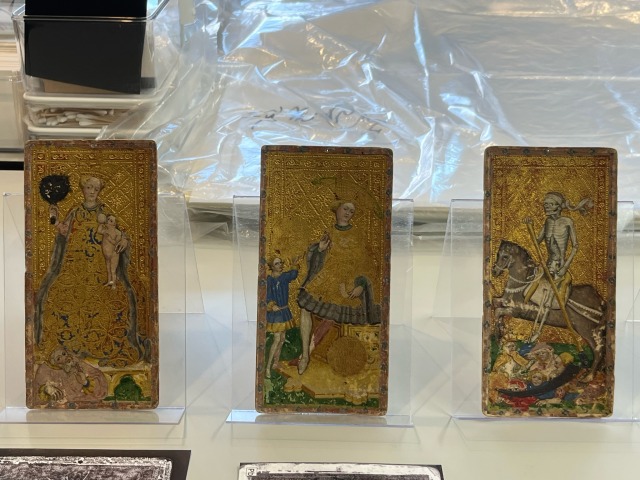
Fifteenth century tarot cards, possibly the oldest known deck. Look how beautiful they are! These are from way back before they were used for cartomancy.
had a fascinating english class that resulted in the notes header “the forcefeminization of victor frankenstein”
what the people want, the people get
you see
my professor’s take is that mary shelley is feminizing victor throughout the novel, as a way of flipping gender roles and putting a male character through female experiences.
evidence as explained:
victor is creating life. he is putting his health at risk (spends two years with little sleep or socialization) to bring life forth into this world
his illness after he is shocked by the creature coming to life is akin to both ‘hysteria’ and postpartum depression
he pretty much swoons, let’s be honest
henry clerval, a man who has been characterized as manly and heroic, has to chase after damsel-in-distress victor and care for him as he convalesces
afterward, he hides what he did and went through, for fear that others will label him crazy and emotional and not believe him. sound familiar?
Victor in general is more emotional than the other characters and is constantly tempering his reactions to not be seen as irrational
the book does not otherwise have central female characters
Also, Shelley’s mother died in childbirth. It’s interesting, then, that Shelley presents the creation of life as something horrific and damaging. She parallels Victor with her mother.
in conclusion, Frankenstein (1818) by Mary Wollstonecraft Shelley is one of the first examples of mpreg in English literature
Oh you KNOW a find is good when even the Tagesschau reports on it! (I saw it on TV last week and literally almost screamed.) And this truly is spectacular – Roman cylinder locks are normally a) WAY bigger (the lock is only 1.2 cm x 1.1 cm, that’s less than half an inch tall and wide), and b) NOT made out of gold.
The find was made by local hobby archaeologist and licensed metal detectorist Constantin Fried on a field near Petershagen and turned over to the appropriate governing body, the LWL-Archäologie für Westfalen, in 2023. Since then, it has been subjected to a variety of analysis methods. We now know that it worked, that the internal mechanism is made of iron, and that it probably dates to the 3rd or 4th century BC. Here, have some cool pictures:
ALTALT
Yes, that is how it was found. Come to Germany and bother a farmer enough that he lets you walk over his field, and you too could find 1,600 year old gold artefacts! (Don’t actually do this, the farmers will get mad at you and the archaeologists don’t like it either. You need a license for metal detectoring in many German states and fieldwalking with the intent to find and keep archaeological material as a private person is illegal, yes, literally.)
ALTALT
This is the large-scale brass reproduction made by one of the restorers at LWL-Archäologie. Since the original was found with a single gold link, it was possible to reconstruct the chain that would have held the lock to whatever it was supposed to hold closed (probably a small box, maybe a jewellery box). In order to work, the chain would have needed a minimum of six links. Also not found but added to the reconstruction: The key.
There’s still a lot of unsolved questions around this find: Where is it from? Was it actually used as a lock, or did its owner wear it as a piece of curious jewellery? The lock seems to have been forced at least once, was this because someone stole the contents of the box it was locking, or was something stuck in the mechanism and the owner couldn’t get at their stuff? And maybe most interesting of all: How was it made? Because, as far as we know, the Romans did not have magnifiying glasses, and this thing is TINY!!! It’s TINY!!!!
Sources (apart from the article link I’m reblogging):






 amhrancas