The great thing about having friends and acquaintances across a variety of professions is to really hammer home as much as possible the fact there is literally zero correlation between the amount someone actually works, the amount they contribute to society, and how much they make in a year.
Me: Did you know that medieval cathedrals weren’t actually supposed to be dark and rundown places with only stained glass as color? They were bright places full of light… the reason they look like that now is because of the centuries of accumulated grime and dust, here look at this restoration of the Cathedral of Chartres in France:
It’s based on actual paint from the times, and when you think about it, it makes a lot more sense, after all a church is supposed to be a bright place of hope. Yet when we think about the middle ages we think about grimy and dark cathedrals. I wonder how much of our conception of history is shaped by our current visions of historical buildings.
My Goth GF: listen, I don’t think this thing between us is working,
ALTALT
Exactly this! So many gothic cathedrals are known as being darker and moody because of age and accumulated dirt like you mentioned, with restorations and cleaning bringing to life what they originally looked like. Another example is the recent restoration of Notre Dame de Paris, it’s absolutely luminous now!
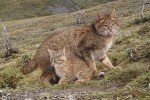
This documentation of a barely-known species of small wild felid is incredible – it’s potentially the first active Chinese mountain cat den ever found! As documented in a recent blog post, a researcher working on a crane conservation project took photos of what he thought was a Tibetan fox, only to discover later that he’d actually photographed a cat so rare it was only discovered as a species in 2007! Researchers returned to the site later and were ecstatic to find that the cat was a mother with two young kittens. The placed a camera trap close to one of the den entrances and was able to record multiple days worth of footage before the family moved on.
Chinese mountain cats (Felis bieti) live in a very small, high-altitude range in remote northern China. They’re well-adapted to the harsh weather at those heights, with a stocky build and thick fur in the winter, and are often called “grass cats” by locals because they blend into the the dry grass of the alpine meadow habitats where they’re most often observed. What little information we have about these elusive felids comes mostly from observations by herders whose livestock graze in those meadows. The IUCN lists that no substantive knowledge has been gained about Chinese mountain cats since 2010, so this new footage from Shan Shui Conservation Center is a major contribution to the scientific understanding of the species.

ALT
ALT
ALT
ALT

ALT
ALT





 amhrancas